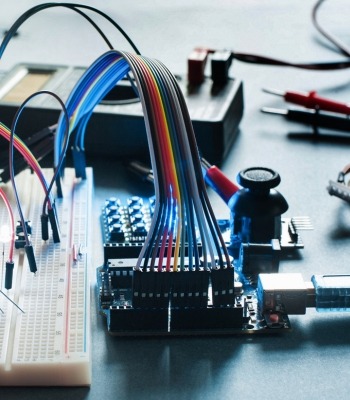
Electric circuits are the foundation of modern technology. From the simplest flashlight to the most complex computer, circuits govern how electricity flows and powers the devices we use daily. In AP Physics 2, electric circuits form a critical unit that explores how energy and charges move through pathways to create functional systems. This blog will break down the concepts of electric circuits, align with the AP methodology of teaching, and connect theory to practical applications that light up our lives—quite literally!
Understanding Electric Current
Electric current is the flow of electric charge through a conductor. The direction of conventional current is defined as the movement of positive charges, though in reality, it is electrons (negative charges) that move. The amount of charge passing through a point in a circuit per second is measured in amperes (A).
Mathematically, current ( I) is defined as:
I =
Where:
- Q is the total charge (in coulombs),
- t is the time (in seconds).
Consider the simplest electric circuit: a battery connected to a bulb. The battery provides the electric potential difference (voltage) needed to push charges through the circuit. The bulb resists the flow, converting electrical energy into light and heat. This simple setup demonstrates how current flows to deliver energy.
In AP Physics 2, students experiment with basic circuits to observe current flow. By varying resistance and voltage, they explore the relationship between these variables, reinforcing theoretical concepts through hands-on inquiry.
Ohm’s Law: The Backbone of Circuit Analysis
Ohm’s Law provides the fundamental relationship between voltage ( V), current ( I), and resistance ( R):
V = IR
This equation shows that the current in a circuit is directly proportional to the voltage and inversely proportional to the resistance.
Imagine a water hose. Voltage is akin to water pressure, resistance is the width of the hose, and current is the flow of water. A higher pressure or wider hose allows more water to flow, just as higher voltage or lower resistance increases current.
AP Physics 2 students often conduct experiments to verify Ohm’s Law. Using a power supply, resistors, and an ammeter, they measure how varying resistance affects current. These experiments solidify their understanding of the linear relationship between voltage, current, and resistance.
Series and Parallel Circuits
Electric circuits can be classified into two main types: series and parallel. Understanding these configurations is essential for analyzing complex circuits.
Series Circuits
In a series circuit, components are connected end-to-end, forming a single pathway for current. Key characteristics include:
- Current: The same current flows through all components.
- Voltage: The total voltage is the sum of the voltages across individual components.
- Resistance: The total resistance is the sum of individual resistances.
Real-life example: Old Christmas lights. If one bulb burns out, the entire string stops working because the current path is interrupted.
Parallel Circuits
In a parallel circuit, components are connected across common points, creating multiple pathways for current. Key characteristics include:
- Current: The total current is the sum of the currents through each pathway.
- Voltage: The voltage across each branch is the same.
- Resistance: The total resistance is less than the smallest individual resistance.
Real-life example: Household wiring. Lights and appliances operate independently because they are connected in parallel.
In AP Physics 2, students build and analyze series and parallel circuits using circuit boards. By measuring voltage, current, and resistance in different configurations, they deepen their understanding of how circuits function.
Power in Electric Circuits
Electric power ( P) is the rate at which energy is transferred or converted in a circuit. It is given by the equation:
P = IV
Using Ohm’s Law, this can also be expressed as:
P = I²R or P =
Power is measured in watts (W), and it determines how much energy a device consumes or produces. For example, a 60-watt lightbulb uses 60 joules of energy per second.
In an AP Physics 2 context, students might calculate the power consumed by different components in a circuit. This analysis not only reinforces mathematical skills but also highlights the importance of energy efficiency in real-life systems.
Kirchhoff’s Laws: Solving Complex Circuits
For more intricate circuits, Kirchhoff’s Laws come to the rescue:
Kirchhoff’s Current Law (KCL): The total current entering a junction equals the total current leaving it.
Kirchhoff’s Voltage Law (KVL): The sum of all voltage drops in a closed loop equals the total voltage supplied.
These laws are essential for analyzing circuits with multiple loops and junctions. For instance, they help engineers design power grids and electronic devices.
In AP Physics 2, students apply Kirchhoff’s Laws to solve circuit problems. They might use a multimeter to measure current and voltage, verifying their calculations experimentally. This hands-on approach bridges the gap between theory and practice.
Resistor-Capacitor (RC) Circuits: Timing is Everything
RC circuits, which combine resistors and capacitors, are widely used in timing applications, such as camera flashes and pacemakers. The charging and discharging of a capacitor in an RC circuit follow an exponential pattern:
V(t) = V₀(1 – e⁻ᵐ/τ) (charging)
V(t) = V₀e⁻ᵐ/τ (discharging)
Where:
- V(t) is the voltage at time t,
- V₀ is the initial voltage,
- τ = RC is the time constant.
The time constant (τ) determines how quickly the capacitor charges or discharges. A larger resistance or capacitance results in a slower process.
In AP Physics 2 labs, students might use an oscilloscope to observe the charging and discharging curves of an RC circuit. These experiments illustrate the interplay between resistance, capacitance, and time.
Inquiry-Based Learning: Engaging with Electric Circuits
Inquiry-based learning is central to AP Physics 2, and the study of electric circuits offers numerous opportunities for exploration. Here are some examples:
Design Challenges: Students might design a circuit to achieve specific goals, such as powering multiple bulbs with minimal energy loss.
Troubleshooting: Analyzing faulty circuits teaches students to apply their knowledge critically and creatively.
Simulations: Virtual labs allow students to experiment with complex circuits that might be difficult to build physically.
These activities not only prepare students for the AP exam but also develop problem-solving skills that are invaluable in engineering and technology fields.
Real-Life Applications of Electric Circuits
Electric circuits are everywhere, powering the technologies that define modern life. Here are a few examples:
- Smartphones:
- Complex circuits inside smartphones manage everything from charging to processing data.
- Electric Vehicles:
- Circuits control the flow of energy from the battery to the motor, maximizing efficiency.
- Medical Devices:
- Pacemakers, defibrillators, and other devices rely on precisely designed circuits to function effectively.
- Renewable Energy:
- Solar panels and wind turbines use circuits to convert and store energy efficiently.
By connecting classroom concepts to these real-world applications, AP Physics 2 students gain a deeper appreciation for the power of electric circuits.
Mastering Electric Circuits for the AP Exam
To excel in the electric circuits unit on the AP Physics 2 exam, follow these tips:
- Understand the Basics:
- Ensure you can apply Ohm’s Law and analyze simple circuits confidently.
- Practice Problem-Solving:
- Work through past AP questions, focusing on free-response problems that involve series, parallel, and complex circuits.
- Engage in Labs:
- Hands-on experiments reinforce theoretical knowledge and improve your ability to interpret data.
- Use Resources Wisely:
- Take advantage of AP-specific textbooks, online tutorials, and study guides to strengthen your understanding.
Conclusion
Electric circuits are the invisible highways that power our world, from the smallest gadgets to the largest power grids. By mastering the principles of current, voltage, resistance, and energy conservation, AP Physics 2 students can unlock the secrets of how circuits work and apply this knowledge to real-world challenges.
For more information on the AP Physics 2 curriculum, check out the official AP Physics 2 Course Overview. Dive into the world of electric circuits and let your curiosity illuminate the path to discovery!