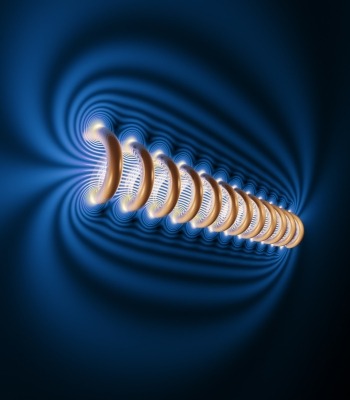
Magnetism and electromagnetism might seem like abstract physics concepts, but they are integral to our daily lives. From the way your GPS works to the wireless charging of your phone, these phenomena govern countless technologies that define modern living. In AP Physics 2, magnetism and electromagnetism form a crucial unit, combining theoretical understanding with practical applications. This blog will explore the fascinating interplay of magnetic fields and electric currents, staying true to the AP methodology of inquiry-based learning while connecting these concepts to real-world scenarios.
What Are Magnetic Fields?
Magnetic fields are invisible regions around a magnet where magnetic forces are exerted. They are represented by field lines, which always point from the north pole to the south pole of a magnet. The strength of a magnetic field is measured in teslas (T).
In everyday life, you’ve likely seen magnetic fields in action when using a compass. A compass needle aligns itself with Earth’s magnetic field, helping travelers and adventurers navigate. This simple tool is a practical demonstration of how magnetic fields influence materials like iron and steel.
Mathematical Representation
The magnetic field ( B) due to a straight current-carrying wire at a distance ( r) is given by:
B =
Where:
- μ₀ is the permeability of free space (≥ 4π × 10⁻⁷ T·m/A),
- I is the current in the wire,
- r is the distance from the wire.
In an AP Physics 2 classroom, students might explore magnetic fields using small magnets and iron filings. By observing the patterns formed by the filings, they gain a visual understanding of field lines and their direction.
Magnetism and Moving Charges
A fundamental discovery in physics is that moving charges create magnetic fields. This relationship forms the foundation of electromagnetism. When an electric current flows through a conductor, it generates a circular magnetic field around the wire.
Consider the magnetic field produced by the coils in an electric motor. As current flows through the coils, the resulting magnetic field interacts with permanent magnets to create motion. This principle is at the heart of countless devices, from household fans to industrial machines.
Force on a Moving Charge
The force ( F) experienced by a charge ( q) moving through a magnetic field ( B) is given by:
F = qvB sinθ
Where:
- v is the velocity of the charge,
- θ is the angle between the velocity vector and the magnetic field.
This equation explains phenomena like the auroras near Earth’s poles. Charged particles from the Sun are deflected by Earth’s magnetic field, creating the stunning displays of light we call the northern and southern lights.
Magnetic Fields and Current-Carrying Wires
When multiple wires carry current, their magnetic fields can interact, resulting in attraction or repulsion depending on the direction of the currents. Parallel wires with currents in the same direction attract each other, while those with opposite currents repel.
Ampère’s Law
Ampère’s Law relates the magnetic field around a closed loop to the current passing through the loop:
∫ B · dl = μ₀ Iᵖ
This principle is key to understanding devices like solenoids, which are coils of wire that produce a uniform magnetic field when current flows through them. Solenoids are used in electromagnets, which power everything from doorbells to MRI machines.
In AP Physics 2, students often build simple solenoids and measure their magnetic fields. These experiments bridge the gap between theoretical equations and tangible applications.
Electromagnetic Induction: Faraday’s Law
One of the most revolutionary discoveries in physics is electromagnetic induction, first described by Michael Faraday. Faraday’s Law states that a changing magnetic field induces an electric current in a conductor. This phenomenon forms the basis of power generation and transmission.
Mathematical Expression
The induced electromotive force (emf) is given by:
ε = -N
Where:
- ε is the induced emf,
- N is the number of loops in the coil,
- Φ is the magnetic flux.
Think about how electricity reaches your home. Power plants use turbines to rotate coils of wire within magnetic fields, generating electricity through electromagnetic induction. Faraday’s Law explains this process and highlights the connection between magnetism and electric energy.
In an AP Physics 2 lab, students might explore electromagnetic induction by moving a magnet through a coil of wire and measuring the induced current. These hands-on activities reinforce the principles of Faraday’s Law and its real-world implications.
Applications of Magnetism and Electromagnetism
Magnetism and electromagnetism are everywhere, powering technologies that shape our world. Here are a few notable applications:
- Electric Motors:
- Motors convert electrical energy into mechanical energy using magnetic fields. They drive everything from cars to kitchen appliances.
- Transformers:
- Transformers adjust voltage levels in power lines, enabling efficient electricity transmission over long distances.
- Magnetic Resonance Imaging (MRI):
- MRI machines use strong magnetic fields and radio waves to create detailed images of the human body.
- Wireless Charging:
- Devices like smartphones use electromagnetic induction to charge without physical connections.
- Data Storage:
- Hard drives and credit cards rely on magnetic fields to store and read information.
By connecting these applications to classroom concepts, AP Physics 2 students see the relevance of magnetism and electromagnetism in everyday life.
Inquiry-Based Learning: Exploring Magnetism
AP Physics 2 emphasizes inquiry-based learning, encouraging students to explore concepts through experimentation. For magnetism and electromagnetism, this might include:
Building Electromagnets: Students create magnets by wrapping wire around nails and passing current through the wire.
Investigating Induction: Using coils and magnets, students observe how changing magnetic fields generate currents.
Visualizing Fields: Iron filings and compasses help students map magnetic field lines around magnets and wires.
These activities not only prepare students for the AP exam but also foster critical thinking and problem-solving skills.
Mastering Magnetism for the AP Exam
To excel in the magnetism and electromagnetism unit on the AP Physics 2 exam, follow these strategies:
- Understand the Fundamentals:
- Focus on key equations and their applications, like Faraday’s Law and Ampère’s Law.
- Visualize Concepts:
- Use diagrams to represent magnetic fields and their interactions with charges and currents.
- Practice Problem-Solving:
- Work through past AP exam questions to become familiar with the format and types of problems.
- Engage in Labs:
- Hands-on experiments deepen your understanding and improve your ability to interpret data.
Conclusion
Magnetism and electromagnetism are more than just intriguing physics topics; they are the forces behind much of modern technology. By understanding how magnetic fields and electric currents interact, AP Physics 2 students can appreciate the science that powers everything from smartphones to power grids.
For more information on the AP Physics 2 curriculum, check out the official AP Physics 2 Course Overview. Dive into the world of magnetism and electromagnetism, and discover how these forces shape our universe!