Introduction: Bridging the Small and the Vast
Have you ever thought about how the smallest particles in an atom relate to the immense galaxies in the universe? Physics bridges these two extremes, revealing that the rules governing the tiniest particles are connected to the forces shaping the cosmos. From atoms to galaxies, the universe operates on principles that unify the very small and the unimaginably vast.
In IB MYP 5 Physics, you’ll explore how the building blocks of matter connect to the largest structures in the universe. This topic takes you on a journey through the fundamental forces, particles, and phenomena that shape everything from quarks to clusters of galaxies.
Atoms: The Universe’s Building Blocks
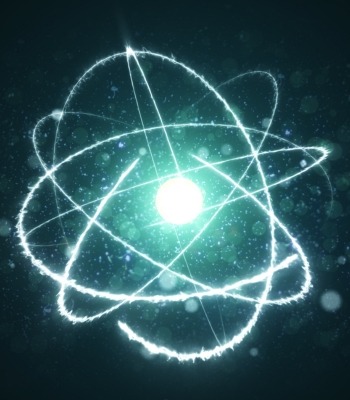
Atoms are the smallest units of matter that retain the properties of an element. They’re composed of:
Protons and Neutrons:
- Found in the nucleus and made up of quarks.
- Held together by the strong nuclear force.
Electrons:
- Negatively charged particles orbiting the nucleus.
Fun Fact: If an atom were the size of a stadium, its nucleus would be the size of a marble!
The Four Fundamental Forces
From the scale of atoms to galaxies, four fundamental forces govern the universe:
Strong Nuclear Force:
- Binds protons and neutrons in the nucleus.
- Operates at the atomic scale.
Weak Nuclear Force:
- Responsible for radioactive decay.
Electromagnetic Force:
- Governs interactions between charged particles.
- Explains phenomena like light and magnetism.
Gravitational Force:
- The weakest force but dominates at large scales, shaping planets, stars, and galaxies.
Galaxies: The Universe’s Cities
Galaxies are the massive systems where stars, gas, and dark matter are bound together by gravity. They range from small dwarf galaxies to massive ones like the Milky Way.
Structure of a Galaxy:
- Core: Contains a supermassive black hole.
- Arms: Spiral galaxies have arms filled with stars, gas, and dust.
- Dark Matter Halo: Invisible matter that makes up most of the galaxy’s mass.
Connecting the Scales: Atoms to Galaxies
Physics reveals that the rules governing the atomic scale also influence cosmic phenomena:
Stellar Nucleosynthesis:
- Stars create heavier elements by fusing atomic nuclei. These elements form the building blocks of planets and life.
Cosmic Forces:
- Gravity binds galaxies, while electromagnetic forces create the light we see from stars.
Quantum and Relativity:
- Quantum mechanics explains the behavior of particles in stars.
- General relativity governs the motion of galaxies and black holes.
The Big Picture: The Expanding Universe
The universe began with the Big Bang, a singularity that expanded to create space, time, and matter. Key concepts include:
Cosmic Microwave Background (CMB):
- The faint radiation left over from the Big Bang, providing clues about the early universe.
Dark Matter and Dark Energy:
- Dark matter holds galaxies together, while dark energy drives the universe’s expansion.
The Observable Universe:
- Stretching 93 billion light-years across, containing trillions of galaxies.
Hands-On Experiments: Exploring Connections
While you can’t observe galaxies directly, you can explore their principles through engaging activities:
Build a Scale Model of the Universe:
- Represent atoms, planets, stars, and galaxies using objects of different sizes.
- What You’ll Learn: The immense differences in scale.
Simulating Stellar Fusion:
- Use diagrams and energy transfer models to understand how atoms fuse to create heavier elements.
- What You’ll Learn: How stars power the universe.
Visualizing Gravity:
- Use a stretched fabric sheet and weights to model how gravity bends spacetime.
- What You’ll Learn: How the same force affects both small particles and galaxies.
Common Misconceptions About Scales in Physics
Misconception: “Atoms and galaxies are completely separate fields of study.”
- Truth: Physics connects the behavior of atoms to the dynamics of galaxies.
Misconception: “Galaxies are static.”
- Truth: Galaxies are dynamic, constantly moving and interacting.
Misconception: “Only large forces like gravity shape the universe.”
- Truth: Forces like electromagnetism play a crucial role in shaping stars and galaxies.
The Future of Scale Research
Scientists continue to bridge the small and the vast through cutting-edge research:
Quantum Gravity:
- Efforts to unify quantum mechanics with general relativity.
Dark Energy Studies:
- Investigating the mysterious force driving the universe’s expansion.
Astrobiology:
- Exploring how the building blocks of life, created in stars, could lead to life on other planets.
Why This Matters for Students
Understanding the connection between atoms and galaxies helps you appreciate the unity of physics and develop skills for the future:
Interdisciplinary Thinking: See how different fields of science connect.
Problem-Solving: Apply physics principles across scales.
Global Perspective: Understand humanity’s place in the universe.
Conclusion: The Science That Connects Us All
From the tiniest particles to the largest galaxies, the universe is a connected web of matter and forces. Through IB MYP 5 Physics, you’ll explore how these scales interact, shaping everything from atoms to the cosmos.
This topic isn’t just about learning—it’s about understanding the big picture of existence. So, are you ready to discover the science that connects it all?